Price is a poor authenticity indicator; only systematic verification of material, heat treatment, and batch traceability prevents catastrophic failures and hidden costs.
Distinguishing genuine from aftermarket bearings requires a structured authentication process that goes far beyond visual inspection. Most counterfeits are priced deceptively close to market value, making price-based assumptions unreliable. The only dependable method involves verifying material certifications, dimensional precision against OEM specifications, and full batch traceability from authorized sources. Industrial buyers who implement systematic verification protocols reduce unplanned downtime significantly and eliminate the cascading costs of premature bearing failures.
I started on the shop floor in Wuxi doing precision inspections before moving to the export desk. A few years back, a steel mill client in Saudi Arabia received a batch of spherical rollers—genuine SKF, but the batch prefix didn’t match what their procurement team expected from new stock. They assumed aftermarket relabels and nearly rejected the entire container at Jeddah. I had to pull SKF China’s traceability logs, cross-check laser-etched codes, and fly out with a third-party inspector to prove every unit was factory-original . That kind of mix-up—genuine vs. aftermarket confusion—is exactly what this piece tackles. I’ve been sourcing bearings out of Shenzhen for years, mostly dealing with European and Middle Eastern buyers who want SKF but can’t wait extended factory lead times, so I know exactly what to look for when a batch rolls in.

The reality is that sophisticated counterfeiters have evolved their tactics to bypass superficial checks. Understanding how to authenticate bearings systematically—and how to identify suppliers who can provide verifiable documentation—has become a critical competency for procurement managers and maintenance engineers operating across multiple regions.
Why Does Bearing Authentication Matter for Industrial Operations?
Counterfeit bearings cause substantial annual losses through unplanned downtime, emergency labor expenses, and secondary equipment damage that far exceeds the initial component cost. The financial impact extends well beyond the price difference between genuine and aftermarket products. When a bearing fails prematurely in critical equipment, the cascading effects—production halts, rushed replacement orders, collateral damage to shafts and housings—multiply the true cost exponentially .
| Operational Impact | Cost Category | Severity Level |
|---|---|---|
| Unplanned downtime | Production loss per hour | Substantial for mining and steel operations |
| Emergency bearing replacement | Labor premium for urgent repairs | Noticeably higher than planned maintenance |
| Secondary equipment damage | Collateral component failure | Frequent consequence of premature bearing failure |
| Emergency inventory holding | Capital tied up in safety stock | Significant burden on maintenance budgets |
I worked with a steel mill maintenance manager experiencing recurring conveyor bearing failures after they switched to cheaper aftermarket suppliers. Their 6309 deep groove ball bearings (C3 clearance, 2RS seal) were failing within weeks instead of delivering the expected L10 life, resulting in extended unplanned downtime monthly. After implementing our genuine product supply with full traceability documentation, they reduced failure rates substantially and eliminated emergency production halts entirely. The key difference wasn’t just the product quality—it was the ability to verify each bearing’s manufacturing source and material certification before installation .

The wind power sector presents an even more cautionary scenario. I recall a spindle return accident where a wind energy operator had mixed aftermarket components into their turbine gearbox maintenance program. The bearings appeared dimensionally correct during receiving inspection, but material composition and heat treatment specifications deviated from OEM requirements. Within months, premature fatigue failures began appearing across multiple units, forcing emergency turbine shutdowns during high-wind seasons when revenue potential was greatest. The root cause analysis revealed that the aftermarket supplier had no verifiable connection to the original manufacturing source—no batch traceability, no material certifications, no heat treatment records .
- Conduct a Failure Cost Analysis – Calculate your facility’s true cost of bearing failures by including downtime, labor, replacement parts, and secondary damage expenses
- Map Critical Applications – Identify which equipment bearings pose the highest risk of catastrophic failure if counterfeit
- Establish Baseline Performance Metrics – Document expected service life and failure patterns for genuine bearings in key applications
- Implement Traceability Requirements – Make full manufacturing source documentation a mandatory requirement for all bearing purchases
How Can You Systematically Identify Genuine Bearings?
Visual inspection alone misses a significant portion of counterfeit bearings that appear convincing to the untrained eye. Sophisticated fakes replicate packaging, markings, and even surface finish to a degree that passes casual receiving checks. Authenticating bearings reliably requires a multi-dimensional verification approach that examines material composition, dimensional precision, heat treatment quality, sealing integrity, lubrication specifications, anti-counterfeiting features, and documentation traceability .
| Verification Dimension | Common Mistake | Correct Authentication Method |
|---|---|---|
| Material Composition | Assuming visual appearance indicates material quality | Request and verify material certification reports with batch traceability |
| Manufacturing Tolerances | Accepting "close enough" dimensional measurements | Use calibrated equipment to verify critical dimensions against OEM specifications |
| Heat Treatment | Relying on coloration to judge hardness | Verify hardness test results from certified laboratories |
| Sealing Systems | Checking only for presence of seals | Testing seal integrity and material composition against specifications |
| Lubrication | Assuming all lubricants are equivalent | Verify lubricant type, quantity, and contamination levels |
| Packaging | Accepting professional-looking packaging as proof | Checking for anti-counterfeit features like holograms and micro-engraved logos |
| Documentation | Accepting generic certificates | Requiring detailed traceability documents linking to specific manufacturing batches |
One of our mining industry clients faced extended production downtime when their grinding mill main shaft bearing failed unexpectedly. They needed to verify the authenticity of replacement stock from multiple suppliers for their 230/630 spherical roller bearings (precision class P6, tapered bore). Our technical team conducted failure analysis and discovered counterfeit lubrication as the root cause—the aftermarket bearings contained substantially less grease than specified, with incompatible additives that accelerated wear . By implementing our verification process combining visual inspection with material certification review, they established a reliable authentication protocol that has prevented similar incidents.
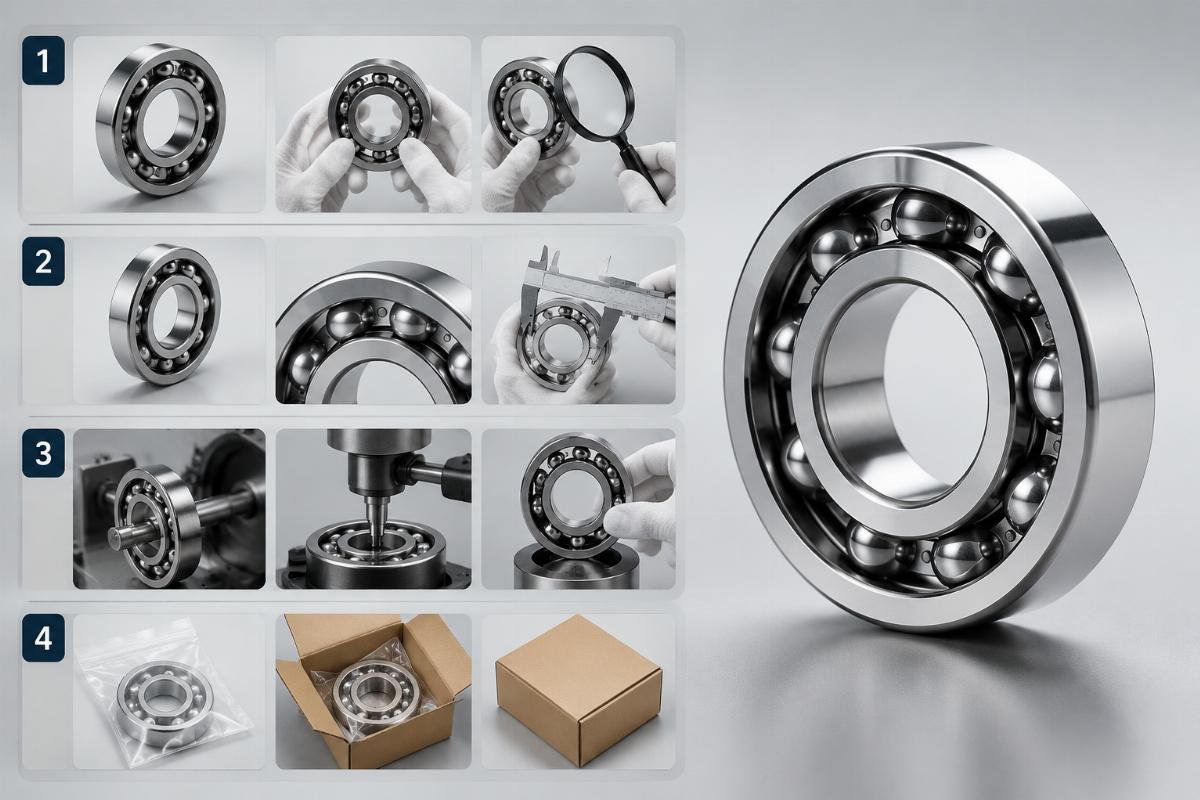
The authentication process must address both physical characteristics and documentary evidence. Physical verification includes examining anti-counterfeit holograms with manufacturer-specific patterns, inspecting micro-engraved logos on bearing rings using magnification, and performing dimensional checks against published specifications. Documentary verification requires confirming chemical composition matches OEM specifications, validating anti-counterfeiting codes through manufacturer-provided tools, and reviewing batch traceability records that link each bearing to its original production run.
- Check Packaging Holograms – Verify anti-counterfeit holographic labels with manufacturer-specific patterns
- Inspect Logo Micro-engraving – Use magnification to check for precision logo engraving on bearing rings
- Review Material Certifications – Confirm chemical composition matches OEM specifications
- Validate Anti-counterfeiting Codes – Use manufacturer-provided tools to verify unique product codes
- Perform Dimensional Checks – Measure critical dimensions against published specifications
What Should You Look for in a China Bearing Supplier?
Reliable Chinese bearing suppliers demonstrate transparency through manufacturing source documentation rather than making vague quality claims. The distinction between authorized distributors and trading companies becomes critical when traceability matters. Authorized distributors maintain direct supply relationships with manufacturers, can provide verifiable batch numbers, and carry the full range of precision classes and special designations. Trading companies, while offering broad product selection and consolidated shipping, often cannot provide the documentary evidence required for critical applications .
| Sourcing Model | Traceability Level | Quality Assurance | Documentation Depth |
|---|---|---|---|
| Direct from Manufacturer | Full batch-level traceability | Consistent quality control | Complete material and process records |
| Authorized Distributor | Factory-backed verification | Technical expertise available | Batch numbers verifiable against manufacturer records |
| Trading Company | Sample-level at best | Variable quality across batches | Limited or generic certificates |
| Online Marketplaces | Not provided | Minimal quality control | High counterfeit risk, scarce documentation |
Our experience supporting wind energy asset managers illustrates the importance of supplier verification. One client needed turbine gearbox bearing replacements meeting OEM-equivalent specifications for extended service life. Their NN3034 cylindrical roller bearings (hybrid ceramic, ISO 14644 Class 8 cleanroom standard) required specialized manufacturing processes and material certifications. By providing complete traceability documentation and DNV certification, we demonstrated our ability to meet their stringent requirements . As an authorized SKF distributor with direct supply from SKF China and SKF global HQ, we maintain full batch traceability on every shipment and can verify batch numbers against SKF records. Our deep stock of rare designations—including large bore, special precision classes, ceramic and stainless variants—allows us to ship within extended hours rather than waiting for factory lead times.

When evaluating potential suppliers, verification should extend beyond surface-level claims. Confirming ISO 9001 and IATF 16949 certifications through official registry checks provides baseline assurance. Requesting factory audits—whether virtual or in-person—reveals actual quality control processes. Testing product samples through independent laboratories before committing to bulk orders identifies deviations early. Examining how suppliers track products from raw materials to finished goods demonstrates their commitment to traceability. Requesting contact information for clients in similar industries allows reference checks that validate performance claims.
- Verify Certifications – Confirm ISO 9001/IATF 16949 certification with official registry checks
- Request Factory Audits – Insist on virtual or in-person facility inspections focusing on quality control processes
- Test Product Samples – Conduct independent laboratory testing of critical specifications before bulk orders
- Review Traceability Systems – Examine how suppliers track products from raw materials to finished goods
- Check Customer References – Request contact information for clients in similar industries
How to Build an Effective Bearing Authentication Protocol?
A formal authentication protocol dramatically reduces counterfeit acceptance rates in industrial maintenance operations, transforming reactive crisis management into proactive quality control. The most effective protocols combine clear procedures with staff training and documentation management to create a sustainable system that protects against evolving counterfeit tactics. Without systematic protocols, individual inspectors rely on experience and intuition—methods that prove inadequate against increasingly sophisticated counterfeiting operations .
| Authentication Protocol Element | Implementation Standard | Verification Method |
|---|---|---|
| Receiving Inspection Checklist | Must include multi-point verification covering packaging, markings, dimensions, and documentation | Supervisor sign-off required for each shipment |
| Staff Training Program | Maintenance technicians complete certification on counterfeit detection techniques | Annual refresher training with updated threat intelligence |
| Documentation Management | Traceability records maintained with batch-level detail | Audit-ready filing system with digital backup |
| Supplier Qualification | Periodic re-verification of supplier credentials and performance | Annual audit of authorized distributor status |
| Failure Analysis Integration | Root cause investigation includes authenticity verification | Cross-reference failed bearings with batch records |
Building an effective protocol requires commitment from both procurement and maintenance teams. Procurement must establish traceability requirements in purchase orders and supplier contracts, making full documentation a condition of payment. Maintenance teams must implement receiving inspection procedures that go beyond counting boxes—examining packaging integrity, verifying markings against purchase orders, checking dimensional samples, and filing all certificates and traceability documents. When failures occur, root cause analysis must include authenticity verification to distinguish between genuine product failures and counterfeit-induced problems.
The protocol should address the full lifecycle from procurement through installation and failure analysis. Procurement specifications must require batch traceability and material certifications. Receiving inspection checklists must verify anti-counterfeiting features and dimensional compliance. Installation records must link each bearing to its batch number for future reference. Failure analysis procedures must include material testing and comparison to original specifications when premature failures occur.
- Establish Procurement Requirements – Mandate batch traceability and material certifications in all purchase orders
- Develop Receiving Inspection Procedures – Create detailed checklists covering physical and documentary verification
- Implement Staff Training – Certify maintenance technicians in counterfeit detection techniques
- Maintain Documentation Systems – File all certificates and traceability records in audit-ready format
- Integrate Failure Analysis – Include authenticity verification in root cause investigations for premature failures
Conclusion
Systematic bearing authentication protects industrial operations from the hidden costs of counterfeit components. Price-based assumptions about authenticity prove unreliable when sophisticated counterfeits are priced deceptively close to genuine products. Multi-dimensional verification—examining material certifications, dimensional precision, heat treatment quality, and batch traceability—provides the only dependable method for distinguishing genuine bearings from aftermarket alternatives. Authorized distributors with direct manufacturer relationships and verifiable traceability systems offer the documentation depth required for critical applications, while formal authentication protocols transform individual inspection efforts into sustainable quality assurance programs that reduce unplanned downtime and eliminate the cascading costs of premature bearing failures.

Leave a Reply