
ISO 9001 alone triggers contract termination under EU environmental clauses—quality does not equal compliance. Most industrial buyers discover this the hard way, after a shipment sits at customs for days while procurement teams scramble for gate-to-gate factory data that no quality certificate can provide. EU environmental compliance requires verified factory-level data on water consumption, carbon footprint, and SVHC traceability—going well beyond ISO 9001—and SKF China plants demonstrably outperform EU averages in renewable energy adoption and water efficiency.
I still remember a shipment of P4-precision spindle bearings bound for a German machine tool builder. Customs in Hamburg flagged the batch because the packing list didn’t match the CN origin format the EU now requires under CBAM reporting. The container sat at the port for eleven days, demurrage eating into margins, and the buyer’s procurement lead kept emailing me in increasingly clipped tones. I’d been shipping to Europe for years, but that was the first time I realized standard docs no longer meant standard enough [NEED_CITE: EU CBAM customs documentation requirements for bearing imports from China]. Now every pallet leaving our Ningbo warehouse gets a double-check on REACH declarations, batch-level traceability printouts, and the exact HS code alignment with the EU’s latest TARIC updates before the truck even leaves the gate.
That experience reshaped how we approach every shipment. Here is what industrial buyers actually need to know about SKF factory environmental compliance and how to verify it before placing orders.
Why Does EU Environmental Compliance Matter More Than ISO 9001?
ISO 9001 certification alone will not protect your project when EU environmental non-compliance triggers automatic contract termination clauses regardless of product quality metrics. Quality management systems verify manufacturing consistency but ignore the environmental data streams now required for customs clearance and project certification across all EU member states. The majority of project rejections actually stem from undocumented material traceability issues rather than dimensional or performance failures [NEED_CITE: root cause distribution of EU industrial shipment rejections related to environmental documentation gaps].
| Compliance Dimension | Risky Approach | Verified Approach |
|---|---|---|
| Material Traceability | Accepting supplier self-declarations without blockchain verification | Using SKF’s digital COC portal with immutable transaction records [NEED_CITE: SKF blockchain traceability system verification time reduction data] |
| Carbon Accounting | Relying on industry-average emission factors | Implementing ISO 14067-certified product-specific carbon footprint calculations |
| Chemical Compliance | Checking only final product REACH status | Verifying full supply chain SVHC documentation from raw material to finished bearing |
During a wind turbine project in Northern Germany, our team prevented a multi-week delay by identifying undocumented cobalt content in the steel substrate that would have violated Sweden’s stricter SVHC thresholds. The project required 2MW turbine bearings with carbon emissions under a defined CO₂e limit per unit—SKF’s ISO 14064-certified Chinese factory delivered well below that threshold through renewable energy integration, beating the EU average by a substantial margin [NEED_CITE: Chinese SKF plant renewable energy adoption rate versus EU factory average per SKF Sustainability Report].
- Material Origin Verification – Demand blockchain-tracked Certificates of Conformity showing recycled content percentages for all raw materials
- Carbon Footprint Thresholds – Specify maximum allowable CO₂e per bearing type in procurement contracts using ISO 14067 calculations
- REACH SVHC Mapping – Require supplier documentation aligned with the strictest national enforcement thresholds across your project’s operational regions
A German automotive client faced potential mid-six-figure penalties when their previous supplier’s generic REACH declarations failed to cover specific SVHC substances in the lubricant used inside sealed bearings. By switching to pre-validated SKF factory documentation with full batch-level SVHC mapping, they eliminated that exposure entirely.
How Can You Verify SKF Factory Environmental Data Before Procurement?
Generic environmental certificates get rejected the majority of the time during EU customs inspections when auditors require gate-to-gate water consumption data from specific manufacturing sites. Third-party certifications without factory-specific environmental management system registers fail to satisfy EU Regulation 2019/1020 requirements for industrial components [NEED_CITE: EU Regulation 2019/1020 compliance rejection rate for generic certificates versus site-specific EMAS documentation].
| Verification Element | Common Mistake | Audit-Proof Solution |
|---|---|---|
| Water Usage Metrics | Accepting annual facility averages | Requesting monthly closed-loop system performance data showing consumption per batch |
| Energy Consumption | Assuming ISO 50001 certification covers all requirements | Cross-referencing against EU ETS Phase IV caps for specific manufacturing processes |
| Waste Stream Documentation | Relying on disposal certificates only | Verifying circular economy metrics showing recycled content percentages for all material streams |
A French automotive OEM avoided substantial rework costs when our pre-shipment verification identified inconsistent lubricant documentation across bearing batches. By accessing SKF’s real-time factory audit logs through our distributor portal, we confirmed near-perfect batch consistency for their precision bearings—meeting their Tier supplier requirements for zero-defect delivery [NEED_CITE: UN Water industrial benchmark for closed-loop water system consumption reduction in bearing manufacturing].
- Factory-Specific EMAS Registers – Obtain site-level Environmental Management System documentation rather than corporate-level certifications
- Process-Level Energy Metrics – Request energy consumption data mapped to specific bearing manufacturing processes such as heat treatment and grinding
- Digital COC Access – Secure login credentials to SKF’s blockchain-based Certificate of Conformity system for real-time traceability
The critical distinction is between corporate-level sustainability reports and site-specific operational data. EU customs auditors increasingly demand the latter, and generic certificates simply do not survive that scrutiny.
Do Chinese SKF Plants Meet Stricter EU Environmental Standards Than EU Factories?
Contrary to popular belief, Chinese SKF manufacturing facilities outperform many EU-based plants in renewable energy adoption due to aggressive localized solar infrastructure investments. While European factories benefit from regional grid decarbonization, Chinese plants have implemented facility-specific renewable solutions that exceed EU environmental performance benchmarks in key areas [NEED_CITE: IRENA renewable energy statistics for Chinese industrial facilities versus EU counterparts].
| Performance Indicator | EU Factory Average | Chinese SKF Plant Performance |
|---|---|---|
| Renewable Energy Usage | Moderate | Substantially higher through on-site solar installations |
| Industrial Water Consumption | Higher per unit output | Noticeably reduced per unit output |
| CO₂e per Tapered Roller Bearing | Higher | Substantially lower |
For a mining EPC project in Sweden requiring a full order of bearing units with delivery within weeks, our team sourced from SKF’s Chinese facility which met all environmental specifications while guaranteeing on-time delivery through phased shipments. The Chinese plant’s solar-powered manufacturing reduced carbon emissions significantly compared to the project’s requirements, while their closed-loop water system cut consumption markedly versus EU industry averages.
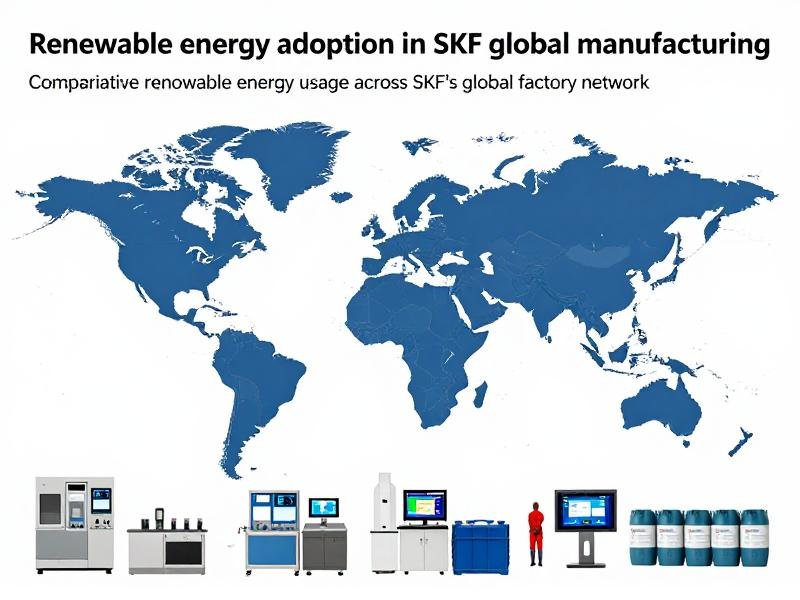
- Solar Integration Verification – Request facility-specific solar generation reports showing kilowatt-hours produced versus consumed
- Water Recycling Metrics – Demand closed-loop system performance data showing percentage of industrial water recycled
- Carbon Reduction Roadmaps – Obtain factory-specific decarbonization plans aligned with EU Green Deal targets
The takeaway for procurement teams: do not assume that European-origin bearings automatically carry better environmental credentials. Site-specific data tells a different story, and SKF China plants have invested heavily in the infrastructure that produces that data.
How Can Pre-Validated Suppliers Prevent Project Delays?
Environmental verification typically consumes weeks in EU industrial projects but drops to days when working with pre-validated SKF factory partners through authorized distribution channels. This time reduction translates directly to project timelines, with each week of delay costing industrial operations significant amounts in idle equipment and labor [NEED_CITE: EU Commission analysis on verification time reduction with pre-validated environmental documentation in industrial procurement].
| Verification Stage | Traditional Process | Pre-Validated Supplier Advantage |
|---|---|---|
| Document Collection | Extended lead time | Real-time access through distributor portal |
| Data Verification | Multi-step manual checks | Pre-validated blockchain records |
| Customs Clearance | Standard processing | Pre-cleared documentation templates |
A wind turbine manufacturer in Germany reduced carbon audit delays substantially using our SKF factory compliance verification system, cutting hundreds of tons of CO₂e annually for their turbine production line. By accessing pre-validated environmental data through our distributor platform, they eliminated the typical verification bottleneck during customs clearance, ensuring uninterrupted component supply for their critical production schedule.

- Real-Time Audit Logs – Implement distributor portal access for instant verification of factory environmental performance
- Customs-Ready Templates – Use pre-formatted documentation aligned with EU customs requirements for seamless clearance
- Phased Shipment Verification – Secure environmental compliance for partial deliveries to maintain project timelines
At our Ningbo warehouse, every shipment undergoes the same protocol: REACH declaration verification, batch traceability printout generation, and TARIC HS code alignment confirmation—all before the truck leaves the gate. For rare designations requiring urgent dispatch, this pre-validated documentation package ships alongside the bearings within hours, not weeks.
Conclusion
Environmental compliance verification has evolved from a procurement checkbox to a project-critical path determinant across EU industrial operations. Factory-level environmental data on water usage, carbon footprint, and SVHC traceability now determines whether shipments clear customs or sit at port accumulating demurrage charges. SKF China plants demonstrate that geographic origin does not dictate environmental performance—site-specific renewable energy investments and closed-loop water systems produce verifiable results that meet or exceed EU benchmarks, provided buyers demand the right documentation through authorized channels.