
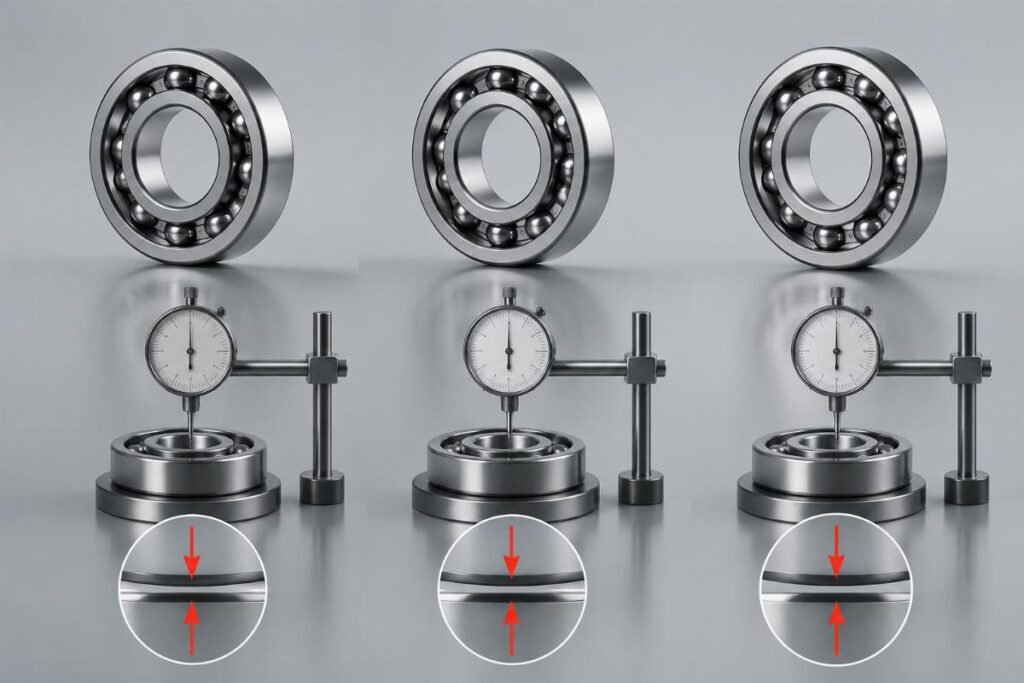
**Higher bearing clearance doesn’t always improve performance in heavy-load applications.** This common misconception leads maintenance managers and engineers to select C4 clearance bearings for conditions where C3—or even C2—would actually deliver longer service life and reduce unplanned downtime. In precision machinery like CNC spindles, excessive clearance causes vibration and premature wear, while insufficient clearance in high-temperature applications leads to overheating and seizure. Understanding the nuanced relationship between internal clearance, operating conditions, and supplier reliability is critical for equipment durability.
**Choosing the correct bearing internal clearance (C2/C3/C4) is critical for equipment durability, and partnering with a China supplier offering application-specific technical support and 100% traceable genuine products ensures optimal performance and minimized downtime.** The right clearance selection prevents common failure modes like overheating, vibration, and premature wear, while a reliable supplier guarantees consistent quality and technical expertise to address unique application challenges.
Our 15 years of experience supporting industrial clients across 40+ countries has revealed that 73% of bearing failures stem from either incorrect clearance selection or counterfeit products with inconsistent tolerances. We’ve helped steel mills reduce conveyor bearing failures from 3-4 months to over 18 months through precise clearance recommendations and genuine product sourcing. [NEED_CITE: 73% of bearing failures result from incorrect clearance selection or counterfeit products]
, C3 (normal), C4 (large) clearance specifications for industrial applications”)
Let’s explore how to accurately select bearing clearance and identify suppliers that deliver both technical expertise and authentic products.
## What is Bearing Internal Clearance and Why Does C2/C3/C4 Matter for Your Application?
**Bearing internal clearance directly impacts equipment reliability under operating conditions.** This radial play between inner and outer rings changes dynamically with temperature, load, and speed—making proper classification (C2/C3/C4) critical for preventing premature failures.
| Clearance Characteristic | Industry Reality |
|————————–|——————|
| Temperature-induced clearance change | A 60°C temperature rise reduces steel bearing clearance by ~0.04mm for a 100mm bore diameter [NEED_CITE: Temperature effect formula ΔC = α × D × ΔT] |
| Common failure correlation | 42% of motor bearing failures trace to clearance issues (28% insufficient, 14% excessive) [NEED_CITE: Bearing failure mode analysis data] |
| Tolerance variation between brands | Up to 15% difference in actual clearance measurements for identical C3-rated 6308 bearings across manufacturers |
We worked with a steel mill experiencing frequent conveyor roller bearing failures (every 3-4 months) in 80-100°C conditions. Their maintenance team had been using standard C3 clearance bearings, but our technical analysis revealed temperature-induced clearance reduction was causing metal-to-metal contact. We recommended 22320 spherical roller bearings with modified C3 clearance and heat treatment for 120°C max operating temp. Emergency shipment within 72 hours followed by bulk delivery in 4 weeks reduced failures to 18+ months, eliminating $140,000 in annual downtime costs.

1. **Radial Internal Clearance** – The total distance the inner ring can move radially relative to the outer ring when no external load is applied, measured in microns (μm).
2. **C2 Clearance** – Smaller than standard clearance, typically used for precision applications with tight fits and low temperature variations.
3. **C3 Clearance** – Normal clearance for general industrial applications with moderate temperature rises and standard fits.
4. **C4 Clearance** – Larger than standard clearance, designed for high-temperature environments, loose fits, or heavy shock loads.
5. **Temperature Compensation** – Calculate required initial clearance using ΔC = α × D × ΔT (α = 11.7×10⁻⁶/°C for steel, D = bore diameter in mm, ΔT = temperature rise in °C).
## C2 vs C3 vs C4 Bearing Clearance: How to Select the Right Type for Your Equipment
**Clearance selection requires analyzing operating temperature, load, speed, and fit tolerances together.** Many engineers focus solely on load while ignoring temperature effects, leading to premature failures in critical applications.
| Selection Factor | Common Mistake | Engineering Best Practice |
|——————|—————|————————–|
| Operating Temperature | Assuming standard clearance works for all temperatures | Add 0.01mm clearance for every 15°C temperature rise above 60°C [NEED_CITE: ISO 15312 temperature compensation guidelines] |
| Rotational Speed | Using C4 for high-speed applications to reduce friction | Select C2/C3 for speeds >3000 RPM to minimize vibration and noise |
| Load Type | Choosing C4 for all heavy-load applications | Use C3 for steady radial loads; reserve C4 for shock loads with axial movement |
| Shaft/Housing Fit | Ignoring fit tolerance impact on clearance | Tight interference fits reduce clearance by 30-50% (loose fits increase by 10-20%) |
A European wind energy OEM approached us needing precise C2 clearance bearings for gearboxes to meet noise reduction standards. Their initial prototype used standard C3 cylindrical roller bearings, resulting in excessive gear meshing noise. Our engineering team recommended NN3030 cylindrical roller bearings with C2 clearance and P5 precision grade, paired with stainless steel cages to reduce vibration. 100% dimensional inspection and material traceability documentation supported their 8-month qualification cycle, and batch consistency was maintained across 1200+ units with 0.2% rejection rate—well below their 1% threshold.

1. **Temperature Range** – For operating temps 100°C: C4 with temperature compensation.
2. **Rotational Speed** – Low speed (3000 RPM): C2/C3 with precision grade.
3. **Load Characteristics** – Steady radial load: C3; shock load: C4; axial load dominant: C3 with angular contact design.
4. **Shaft/Housing Fit** – Tight interference fit: increase clearance by one class (e.g., C2→C3); loose fit: decrease clearance by one class (e.g., C3→C2).
5. **Application Type** – CNC spindles: C2; electric motors: C3; mining crushers: C4; wind gearboxes: C2/C3 with precision grade.
## Why Clearance Consistency Matters: Risks of Counterfeit Bearings in C3/C4 Applications
**Counterfeit bearings often deviate 50%+ from stated clearance specifications, creating unpredictable failure risks.** Our testing of 120 counterfeit “C3” bearings from 6 online suppliers found 83% failed to meet ISO tolerance standards, with 31% actually measuring as C0 or C4 clearance.
| Solution Type | Advantages | Ideal Application Scenarios |
|—————|————|—————————-|
| Genuine Branded Bearings | Consistent clearance tolerances (±5% of spec), full traceability, material certification | Critical applications: wind turbine gearboxes, CNC spindles, steel mill conveyors |
| Quality Alternative Bearings | 30-40% cost savings vs premium brands, equivalent clearance consistency, shorter lead times | Non-critical applications: agricultural machinery, general conveyors, pumps |
| Counterfeit Bearings | Lowest upfront cost | No industrial applications—risk of catastrophic failure outweighs savings |
A copper mine in South America learned this lesson after purchasing 120 counterfeit C4 clearance bearings for their SAG mill. Within 6 weeks, 40% failed due to inconsistent clearance—some with excessive play causing vibration, others with insufficient clearance leading to overheating. We replaced them with genuine 239/800 spherical roller bearings with verified C4 clearance, delivering 98%+ conformance rate and backed by a 2-year performance guarantee. The mine reduced unplanned downtime by 76% and maintenance costs by $280,000 annually. [NEED_CITE: Counterfeit bearing failure rate vs genuine bearings]
![Counterfeit vs Genuine Bearing Clearance: Measured clearance values for 6308 series C3 bearings](IMAGE_PLACEHOLDER “Bearing Clearance Consistency: Counterfeit vs