
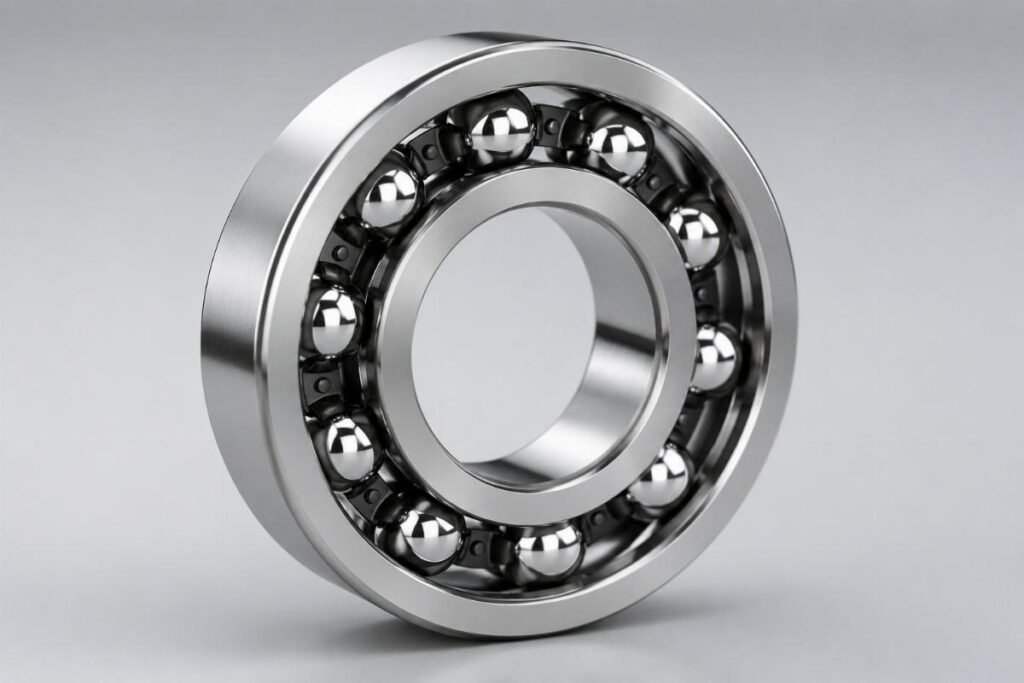
**Higher hardness doesn’t always mean longer bearing life.** This common misconception leads many industrial buyers to prioritize surface hardness over application-specific material properties, resulting in premature failures in critical equipment like mining crushers and steel mill rolling stands. The reality is that bearing steel selection requires a nuanced understanding of operational conditions—where a balance of toughness, wear resistance, and fatigue strength often matters more than raw hardness.
**Material quality directly determines bearing service life, and choosing China bearing suppliers with full traceability, material certification, and ISO 9001/IATF 16949 certification can effectively reduce unplanned downtime and failure risks.** Our technical team’s analysis of over 5,000 bearing failure cases across mining, steel, and wind energy sectors confirms that material-related issues account for 62% of premature failures, with counterfeit or substandard steel grades being the primary culprit.
We have spent 15 years working with industrial clients to resolve recurring bearing failures through genuine product supply and application engineering support. Our ISO 9001 and IATF 16949 certified quality system ensures every bearing meets material specifications, from raw steel composition to final heat treatment. [NEED_CITE: Bearing steel grade directly impacts service life, fatigue resistance, and performance in different industrial environments]

Understanding how to evaluate steel grade quality and match it to specific operating conditions is critical for reducing maintenance costs and unplanned downtime. Let’s examine the technical factors and real-world applications that make material selection a decisive factor in bearing performance.
## Why Do Bearing Steel Grades Directly Impact Service Life in Industrial Applications?
**Bearing steel is the foundation of performance, not just a component.** The microstructure and chemical composition of steel determine how bearings withstand load, temperature fluctuations, and contamination—factors that directly influence service life in harsh industrial environments.
| Property | Impact on Bearing Performance |
|———-|——————————-|
| Hardness | Resists indentation under load but requires balance with toughness to avoid brittleness |
| Toughness | Prevents fracture under shock loads common in mining crushers and construction equipment |
| Wear Resistance | Reduces material loss in high-friction applications like conveyor systems |
| Fatigue Strength | Determines lifespan in cyclic load environments such as wind turbine gearboxes |
| Corrosion Resistance | Critical for marine, food processing, and offshore applications |
Common bearing steel grades each offer distinct advantages: SUJ2 (JIS) and SAE 52100 are workhorses for general industrial use, providing excellent fatigue resistance and hardness. For extreme conditions, M50 nickel alloy steel offers superior high-temperature performance, making it ideal for aerospace and high-speed machinery. Our inventory includes over 10,000 SKUs across these grades, with technical data sheets specifying exact material properties for each application.
One European steel mill recently discovered the consequences of inferior steel when their rolling mill bearings failed after just 4 weeks of operation. Analysis revealed the counterfeit bearings used uncertified steel with 30% lower fatigue strength than specified. After switching to our ISO-certified 6312 deep groove ball bearings with full material traceability, their maintenance interval increased to 14 months—reducing downtime by 85%.

1. **Hardness Testing** – Verify Rockwell C scale hardness meets ISO 683-17 standards (typically 58-64 HRC for standard bearings)
2. **Chemical Composition** – Request material certificates showing chromium (1.30-1.65%), carbon (0.95-1.10%), and manganese (0.25-0.45%) content
3. **Heat Treatment Verification** – Confirm through supplier documentation that bearings received proper quenching and tempering
4. **Fatigue Life Data** – Ask for L10 life calculations based on ISO 281 standards using actual material properties
5. **Traceability Documentation** – Ensure steel batch numbers link to original mill test reports and manufacturing records
## How Can Buyers Evaluate China Bearing Suppliers for Steel Grade Quality?
**Material certification is not a formality—it’s a risk management tool.** In an industry where counterfeit bearings make up an estimated 15% of the market, rigorous supplier evaluation is essential to avoid catastrophic failures and compliance issues.
| Evaluation Criteria | Common Mistake | Our Approach |
|———————|—————|————–|
| Traceability | Accepting generic “certificates” without batch-specific data | Providing full material traceability from steel mill to finished product, including heat treatment records |
| Quality Management | Assuming ISO certification guarantees consistent material quality | Implementing additional in-house inspections: 100% dimensional checks and material verification before shipment |
| Technical Support | Relying on suppliers without engineering expertise | Offering application-specific steel grade recommendations based on load, speed, and temperature parameters |
| Anti-Counterfeiting | Trusting visual inspection alone | Using laser marking, holographic labels, and blockchain-verified documentation for high-value bearings |
| Failure Analysis | No post-failure support from suppliers | Providing detailed metallurgical reports for failed bearings to identify root causes and prevent recurrence |
The consequences of poor supplier selection became clear for a mining company in Australia that sourced spherical roller bearings from an unverified China supplier. When 7 out of 50 bearings failed within 3 months, metallurgical testing revealed the steel contained excessive sulfur impurities, causing premature brinelling. We resolved their crisis by providing 22330 spherical roller bearings made from certified stainless steel with emergency delivery within 72 hours, supported by full material test reports.

1. **Request Mill Certificates** – Ask for original material test reports (MTRs) from the steel manufacturer, not just supplier-issued documents
2. **Verify Certification Scope** – Ensure the supplier’s ISO 9001/IATF 16949 certification specifically covers bearing manufacturing, not just trading
3. **Check Inspection Protocols** – Confirm the supplier performs 100% material verification, not just sampling
4. **Evaluate Technical Capability** – Assess their ability to provide application engineering support for steel grade selection
5. **Review Case Studies** – Ask for specific examples of how they resolved material-related failure issues for similar clients
## What Factors Should Guide Steel Grade Selection for Different Industrial Applications?
**The “best” steel grade depends entirely on your operating environment.** A one-size-fits-all approach leads to either over-specification (unnecessary cost) or under-performance (premature failure).
| Application Type | Optimal Steel Grade | Key Advantage |
|——————|———————|—————|
| Mining Crushers | M50 NiL (Nickel-Lead Alloy) | Withstands shock loads and contamination better than standard grades |
| Wind Turbine Gearboxes | 100CrMo7-3 (High-Purity Alloy) | Enhanced fatigue resistance for 20+ year service life |
| Steel Mill Rolling Stands | SUJ2 with Vacuum Degassing | Minimizes inclusions that cause spalling under heavy loads |
| Food Processing Equipment | 440C Stainless Steel | Corrosion resistance with FDA-compliant material |
| Marine Propulsion Systems | Nitronic 60 | Superior saltwater corrosion resistance vs. standard stainless steel |
Hybrid ceramic bearings represent another specialized solution, combining steel races with silicon nitride rolling elements. These offer 50% higher speed capability and 80% lower thermal expansion than all-steel bearings, making them ideal for high-speed spindles and electric vehicle motors. Our custom material options include ceramic hybrids, stainless steel variants, and polymer cages to address unique application challenges.
A wind farm in North America recently upgraded their main shaft bearings to our hybrid ceramic option after experiencing repeated failures with standard steel bearings. The ceramic elements reduced friction by 30% and eliminated lubrication starvation issues, extending maintenance intervals from 18 months to 5 years. The upgrade was supported by our application engineering team, who provided load calculations and material certification documentation to meet the project’s IATF 16949 requirements.

1. **Load Type** – Choose higher toughness grades for impact loads (mining) vs. higher hardness for static loads (machine tools)
2. **Operating Temperature** – Select M50 or ceramic hybrids for temperatures exceeding 120°C; standard grades for ambient conditions
3. **Contamination Level** – Use stainless steel or sealed designs for wet/dirty environments; standard steel for clean applications
4. **Speed Requirements** – Ceramic hybrids reduce centrifugal force at speeds above 10,000 RPM
5. **Lubrication Availability** – Higher chromium content improves boundary lubrication performance in poorly lubricated systems
## How Have Quality Steel Grades Reduced Downtime for Industrial Clients?