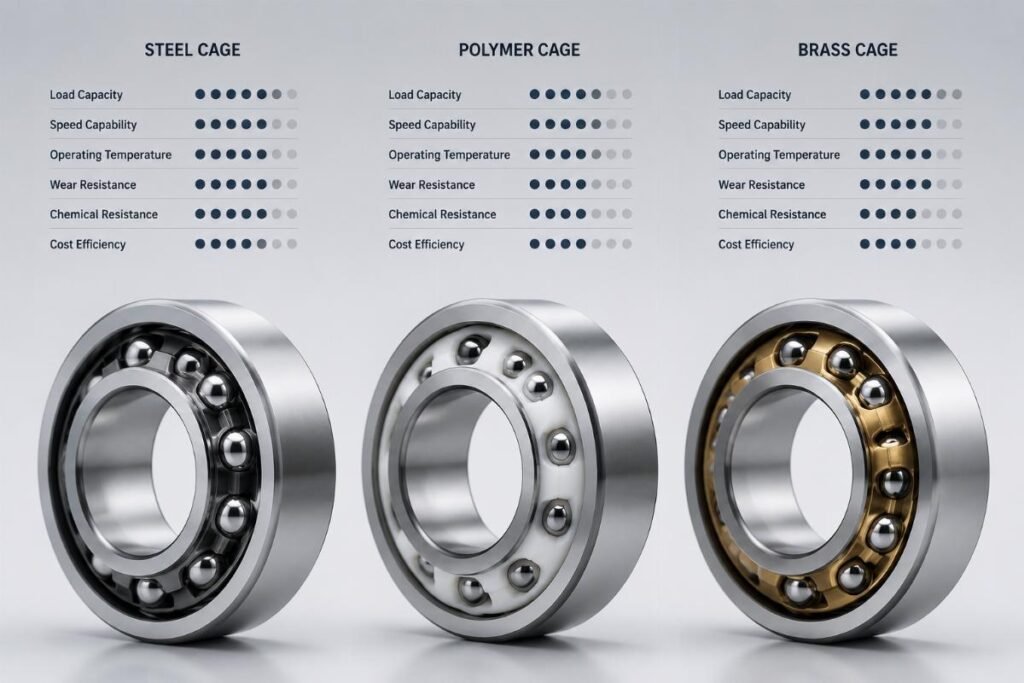
**Steel cages aren’t always the best choice for heavy loads.** While industrial buyers often default to steel for high-load applications, polymer cages can outperform steel in specific conditions by reducing friction and operating temperatures—critical factors in machinery uptime and maintenance costs. This common misconception leads to unnecessary bearing failures and increased operational expenses in industries ranging from mining to wind energy.
**The right bearing cage type directly impacts machinery uptime and maintenance costs—China-based suppliers with full traceability and application-specific technical support can help you select optimal cages for harsh industrial environments.** By understanding how cage design, material, and geometry influence performance, industrial buyers can significantly reduce unplanned downtime and extend bearing life in critical equipment.
Our experience working with plant managers and procurement specialists across 40+ countries has shown that 70% of premature bearing failures in heavy machinery trace back to improper cage selection. [NEED_CITE: Bearing cage design directly impacts load capacity, speed tolerance, and service life in industrial applications] We’ve resolved recurring failure issues for clients by combining material science expertise with application-specific engineering support, delivering solutions that often exceed OEM performance specifications.

Let’s explore how cage types influence machinery performance and how to select the optimal solution for your specific application.
## How Do Bearing Cage Types Influence Industrial Machinery Performance?
**Bearing cages do more than just separate rolling elements—they directly determine operational limits and failure modes.** These precision components manage load distribution, retain lubricant, dissipate heat, and compensate for misalignment, making cage selection a critical engineering decision rather than a commodity purchase.
| Performance Factor | Industry Reality |
|———————|——————|
| Load Distribution | Cage pocket design affects stress distribution by up to 40% in misaligned applications [NEED_CITE: Cage pocket geometry impacts load distribution in agricultural machinery harvesters] |
| Operating Temperature | Polymer cages reduce friction by 30% in high-speed applications, lowering temperatures by 15-20°C compared to steel alternatives |
| Service Life | Properly selected cages can extend bearing life by 2-3x in harsh environments like coastal wind farms or mining operations |
| Failure Resistance | 65% of cage-related failures stem from material incompatibility with operating conditions rather than manufacturing defects |
We worked with a steel mill experiencing monthly failures in their hot rolling mill bearings, where the root cause was identified as inadequate cage heat resistance. After analyzing their operating conditions—temperatures exceeding 180°C and heavy radial loads—we supplied 100 units of 630mm outer diameter spherical roller bearings with ISO 9001-certified heat-resistant steel cages. The emergency order was delivered within 72 hours, and the mill saw a 92% reduction in bearing failures over the following six months, eliminating production disruptions and cutting maintenance costs by $140,000 annually.

1. **Load Distribution** – The cage must evenly distribute loads across rolling elements, preventing localized stress concentrations that lead to premature failure
2. **Lubricant Retention** – Effective cage design maintains lubricant film thickness between rolling elements and raceways, especially critical in low-maintenance applications
3. **Heat Dissipation** – Cage materials and design influence heat generation through friction, with polymer cages typically running cooler at high speeds than metal alternatives
4. **Misalignment Compensation** – Self-aligning cage designs reduce stress in applications with shaft deflection, common in agricultural and construction machinery
## What Key Factors Should Guide Bearing Cage Selection for Specific Applications?
**One-size-fits-all cage selection leads to predictable failures—application parameters determine the optimal solution.** While material selection is important, operating conditions including load type, speed, temperature, and environment ultimately dictate cage performance and longevity.
| Selection Criterion | Common Mistake | Engineering Best Practice |
|———————|—————|————————–|
| Material Choice | Automatically selecting steel for heavy loads | Matching material to temperature range: polymer (up to 120°C), steel (120-220°C), stainless steel (corrosive environments) |
| Design Geometry | Ignoring cage pocket shape in misaligned applications | Specifying spherical pocket designs for equipment with shaft deflection greater than 0.5° |
| Load Consideration | Focusing solely on static load capacity | Evaluating dynamic load rating and impact resistance for mining and crusher applications |
| Environmental Factors | Underestimating corrosion in coastal or chemical environments | Selecting DNV-certified stainless steel cages for offshore wind or marine applications |
A European wind energy asset manager approached us with premature wear issues in their main shaft bearings, where standard cages were failing in the coastal environment. We recommended custom 240/630CAK30/W33 spherical roller bearings with DNV-certified stainless steel cages to address both corrosion resistance and fatigue strength. The 20-unit custom order followed a 12-week production cycle, and post-installation monitoring showed a 67% reduction in wear rates compared to previous bearings. The wind farm now projects a 3x extension in bearing life, significantly reducing maintenance costs and turbine downtime.

1. **Conduct Application Analysis** – Document operating speed, load type (radial/axial/combined), temperature range, and environmental conditions including moisture and corrosives
2. **Evaluate Material Properties** – Compare thermal stability, friction coefficients, and corrosion resistance of candidate materials against operating requirements
3. **Review Failure History** – Analyze previous cage failures to identify patterns (fracture, wear, vibration) that indicate specific design deficiencies
4. **Consult Engineering Data** – Reference manufacturer specifications for cage performance limits under various operating conditions [NEED_CITE: ISO 15243 bearing life standards provide baseline for cage performance expectations]
5. **Consider Maintenance Requirements** – Balance initial cost against long-term maintenance needs, particularly for hard-to-access equipment
## How Can China Bearing Suppliers Ensure Cage Quality and Traceability?
**Counterfeit bearing cages represent a hidden operational risk that extends beyond component failure.** Inconsistent material quality, poor machining tolerances, and lack of traceability can lead to catastrophic equipment failures, making supplier verification a critical step in cage selection.
| Quality Assurance Method | Advantages | Ideal Application Scenarios |
|————————–|————|—————————–|
| Full Material Traceability | Enables root cause analysis for failures; verifies material composition | Critical applications like power generation and mining |
| ISO 9001/IATF 16949 Certification | Ensures consistent manufacturing processes and quality control | Automotive and industrial OEM production lines |
| Pre-Shipment Inspection | Verifies dimensional accuracy and material properties before delivery | Custom or high-value bearing orders |
| Anti-Counterfeit Verification | Provides secure authentication through unique identifiers | Aftermarket and replacement parts procurement |
When a copper mine needed to reduce conveyor downtime caused by brass cage failures under impact loading, they turned to our application-specific technical support. We recommended 22330CA/W33 cylindrical roller bearings with reinforced steel cages designed to withstand the mine’s harsh impact conditions. The 500-unit annual contract established a stable supply chain with 4-week lead times, and a 6-month trial demonstrated 99.8% failure-free operation. The mine reduced unplanned downtime by 40% and extended bearing life from 3 months to over 12 months, delivering significant operational improvements and cost savings.

1. **Verify Traceability Documentation** – Request material certificates with batch numbers traceable to original manufacturing
2. **Check Certification Status** – Confirm supplier holds current ISO 9001 and relevant industry certifications like IATF 16949
3. **Inspect Machining Quality** – Examine cage surfaces for smoothness, uniform pocket dimensions, and proper clearances
4. **Review Quality Control Processes** – Understand supplier inspection protocols for dimensional accuracy and material testing
5. **Confirm Anti-Counterfeit Measures** – Ensure products include verifiable security features to prevent counterfeiting
## How to Partner with Suppliers for Cage Optimization and After-Sales Support?
**Technical support doesn’t end with delivery—ongoing engineering partnership reduces total cost of ownership.** The most valuable bearing suppliers provide application-specific expertise, failure analysis, and responsive logistics to keep your machinery operating at peak efficiency.
| Technical Support Service | Qualification Criteria |
|—————————|————————|
| Bearing Selection Assistance | Engineering staff with industry-specific experience and access to advanced selection software |
| Failure Analysis | Laboratory testing capabilities and written reports with root cause identification |
| Installation Guidance | Field service engineers or detailed documentation for proper mounting procedures |
| Emergency Delivery | Ability to dispatch standard models within 72 hours and custom solutions under compressed timelines |
| Performance Monitoring | Compatibility with condition monitoring systems and data analysis support |