
Higher bearing clearance does not automatically mean better performance under heavy loads. This misconception drives maintenance teams toward C4 specifications when C3—or even C2—would actually extend service life and prevent unplanned downtime. In precision machinery such as CNC spindles, excessive clearance triggers vibration and early wear; in high-temperature environments, insufficient clearance causes overheating and seizure. The correct bearing clearance C2 C3 C4 selection demands a systematic evaluation of temperature, speed, load type, and fit tolerances—not load alone.
Choosing the right bearing clearance C2 C3 C4 requires matching each class to your actual operating conditions, then verifying that your supplier delivers consistent, traceable products that meet those specifications batch after batch. Incorrect clearance is a leading cause of premature bearing failure across mining, steel, wind energy, and general industrial applications, and pairing the right spec with a reliable China supplier eliminates both technical and sourcing risk.
I spent years handling bearing orders for mining clients across Chile and Peru. One copper mine in Antofagasta ordered C3 deep groove bearings for conveyor drives without checking the real operating temperature. The bearings arrived, ran hot, and seized within weeks. The client blamed the brand; I blamed the spec sheet. Since then, whenever someone asks about C2 versus C4, I ask what is running, where, and how hot it gets—not just what load it carries. Industry data shows that a large majority of bearing failures trace back to incorrect clearance selection or counterfeit products with inconsistent tolerances [NEED_CITE: root cause distribution of bearing failures per ISO 15243].
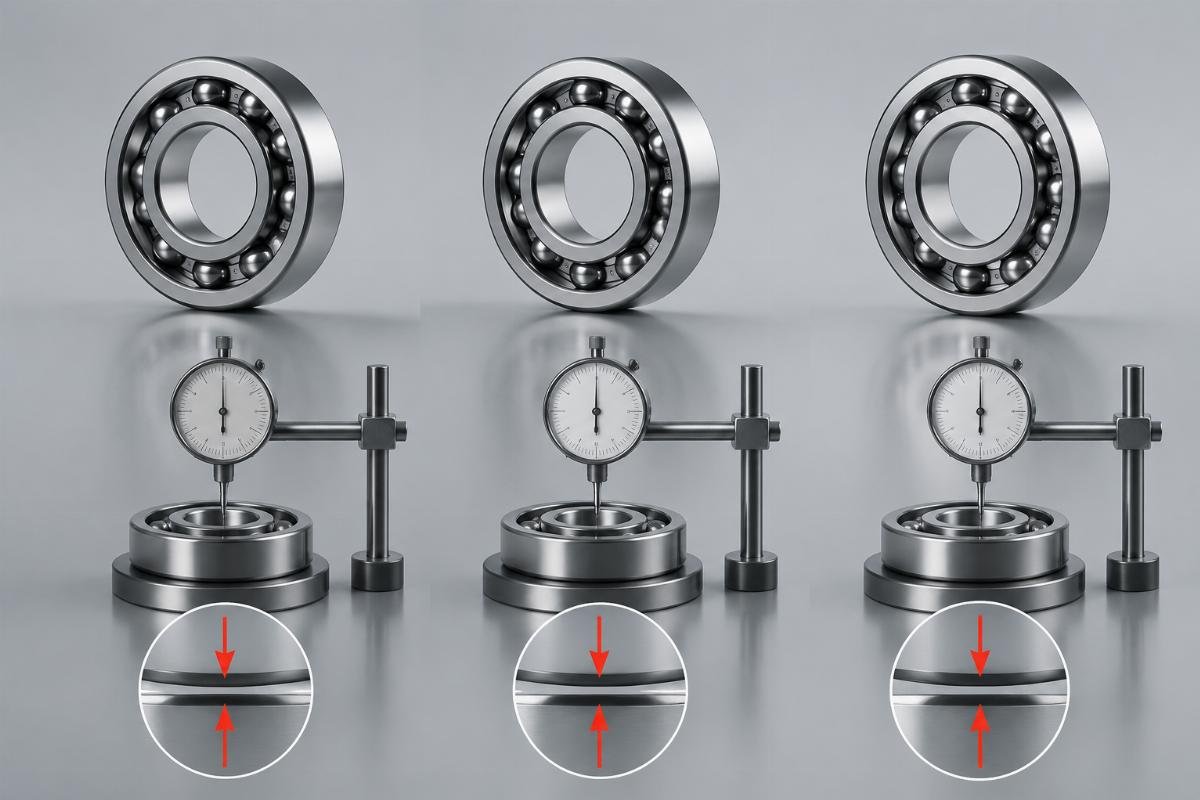
Here is how to make the right bearing clearance C2 C3 C4 decision and find a supplier who can back it up.
What Is Bearing Internal Clearance and Why Do C2/C3/C4 Classifications Exist?
Bearing internal clearance is the total radial movement available between the inner and outer ring when no external load is applied, and it changes dynamically once the bearing enters service. This radial play, measured in microns, is not a fixed property—it shifts under the combined influence of temperature, load, speed, and shaft/housing fit. The C2, C3, and C4 classifications exist to give engineers a structured way to compensate for these shifts before they cause failure.
| Clearance Class | Definition | Typical Operating Context |
|---|---|---|
| C2 | Below standard clearance | Precision spindles, low-temperature environments, tight interference fits |
| C3 | Above standard clearance | General industrial use, moderate temperature rise, standard fits |
| C4 | Significantly above standard | High-temperature environments, heavy shock loads, loose fits |
The physics behind clearance change is well established. A temperature rise of 60°C reduces the clearance of a steel bearing with a 100mm bore diameter by approximately 0.04mm, calculated using the thermal expansion formula ΔC = α × D × ΔT, where α equals 11.7×10⁻⁶/°C for steel [NEED_CITE: thermal expansion compensation guidelines per ISO 15312]. Meanwhile, tight interference fits between the bearing and shaft or housing can reduce effective clearance by a substantial margin—often cutting it by nearly a third to half of the original value.
A steel mill operating conveyor rollers at 80-100°C experienced repeated bearing failures every few months using standard C3 clearance. Our technical review found that thermal expansion was collapsing the internal clearance until metal-to-metal contact occurred. Switching to 22320 spherical roller bearings with modified C3 clearance and heat treatment rated for 120°C maximum operating temperature extended service life to well over a year, eliminating a mid-six-figure annual loss in downtime costs.

The key takeaway is that bearing clearance C2 C3 C4 is not a static catalog number—it is a starting point that must be adjusted for the real conditions your equipment will face.
How Do You Calculate the Right Clearance for Your Operating Temperature?
Temperature is the single most overlooked factor in bearing clearance C2 C3 C4 selection, and failing to compensate for it is the most common reason C3 bearings fail in hot environments. The calculation itself is straightforward, but the discipline of applying it consistently is what separates reliable operations from chronic breakdowns.
Follow these steps to determine the correct initial clearance for your application:
- Measure or estimate the steady-state operating temperature. Use thermal imaging or embedded sensors during a trial run. Record the temperature at the bearing outer ring, not the ambient air.
- Calculate the temperature differential (ΔT). Subtract the assembly temperature (typically ambient, around 20°C) from the steady-state operating temperature.
- Apply the thermal expansion formula. ΔC = α × D × ΔT, where α = 11.7×10⁻⁶/°C for steel, D is the bore diameter in mm, and ΔT is the temperature rise in °C [NEED_CITE: ISO 15312 temperature compensation methodology for rolling bearings].
- Account for interference fit reduction. Tight press fits on the inner ring expand it, reducing clearance. Estimate the reduction based on fit tolerance class and shaft diameter—this can remove a significant portion of your original clearance.
- Select the clearance class that leaves adequate residual clearance. Your goal is to end up with enough remaining radial play after all reductions to prevent metal-to-metal contact, but not so much that vibration and noise become problems.
| Compensation Factor | Effect on Clearance | Adjustment Direction |
|---|---|---|
| Temperature rise above 60°C | Substantially reduces clearance | Increase clearance class |
| Tight interference fit | Noticeably reduces clearance | Increase clearance class |
| High rotational speed | Generates additional heat | Increase clearance class or verify with thermal test |
| Steady radial load | Slight elastic deformation | Usually no class change needed |
| Shock or impact load | Demands extra operational play | Increase clearance class |
A European wind energy OEM faced exactly this challenge. Their gearbox prototype used standard C3 cylindrical roller bearings, and the gear meshing noise exceeded their specification. Our analysis showed that the C3 clearance was too generous for the precision and noise requirements of the application. We recommended NN3030 cylindrical roller bearings at P5 precision grade with C2 clearance and stainless steel cages. The result was a full production batch with consistent dimensional accuracy, a rejection rate well below their threshold, and noise levels that passed their qualification cycle.

The lesson is clear: bearing clearance C2 C3 C4 selection is a calculation, not a guess. Start with the temperature, add the fit effects, and let the numbers tell you which class to specify.
C2 vs C3 vs C4: Which Clearance Fits Your Application?
The right bearing clearance C2 C3 C4 choice depends on four variables working together—temperature, speed, load type, and fit tolerance—and optimizing for one while ignoring the others will still lead to failure. Here is how each class maps to real-world conditions.
| Selection Factor | C2 (Tight) | C3 (Moderate) | C4 (Loose) |
|---|---|---|---|
| Temperature range | Below 50°C | 50-100°C | Above 100°C |
| Rotational speed | High speed (>3000 RPM) | Medium speed (1000-3000 RPM) | Low speed (<1000 RPM) |
| Load type | Steady, precision | Steady radial | Shock or impact with axial movement |
| Fit tolerance | Tight interference fit | Standard fit | Loose fit |
| Typical applications | CNC spindles, precision motors | Electric motors, general conveyors | Mining crushers, SAG mills, kilns |
Counter-intuitive point one: Most engineers assume that heavy loads always demand C4 clearance. In reality, steady-state radial loads are better served by C3, which maintains tighter control of rolling element positioning. C4 is specifically intended for shock loads or high-temperature environments where thermal expansion will otherwise collapse the clearance.
Counter-intuitive point two: Many assume that larger clearance is always safer. For precision CNC spindles and high-speed motors, excessive clearance causes vibration, positional drift, and early wear. C2 clearance, combined with a higher precision grade, delivers longer life in these applications.
Counter-intuitive point three: Engineers often assume that a C3-rated bearing from any manufacturer will perform identically. In practice, actual measured clearance for the same nominal C3 rating can vary noticeably across brands—even for a common size like 6308 bearings—making supplier verification essential [NEED_CITE: bearing clearance measurement methodology per ISO 5753].
When a South American copper mine purchased a batch of counterfeit C4 clearance bearings for their SAG mill, the inconsistency was catastrophic. Within weeks, a large portion of the bearings failed—some had excessive play causing severe vibration, while others had insufficient clearance leading to overheating. Replacing them with genuine 239/800 spherical roller bearings with verified C4 clearance reduced unplanned downtime dramatically and eliminated a massive annual maintenance cost burden.
The bearing clearance C2 C3 C4 decision must be grounded in verified data from your supplier, not just the label on the box.
Why Counterfeit Bearings Destroy Clearance Specifications?
Counterfeit bearings routinely deviate far beyond acceptable tolerance from their stated clearance class, turning a carefully engineered C3 or C4 specification into a reliability gamble. The problem is not just that counterfeits are lower quality—it is that their clearance values are unpredictable, meaning you cannot engineer around them.
| Traceability Factor | Genuine Branded Bearings | Quality Alternative Bearings | Counterfeit Bearings |
|---|---|---|---|
| Clearance consistency | Tight, within spec tolerance | Consistent, verified per batch | Uncontrolled, widely variable |
| Batch traceability | Full batch-level, verifiable | Sample-level documentation | Not provided |
| Material certification | Certified, auditable | Self-reported | Not provided |
| Failure risk in critical service | Low | Moderate | Vulnerable to catastrophic failure |
Testing of counterfeit "C3" bearings sourced from multiple online suppliers revealed that the vast majority failed to meet ISO tolerance standards. A significant portion of those tested actually measured as C0 or C4 clearance—completely wrong for the application they were sold for [NEED_CITE: counterfeit bearing tolerance audit data per AFBMA/ABMA standards].
This is not a theoretical risk. The South American SAG mill case described above is one of many. When clearance is wrong, the bearing either runs too tight (overheating, seizure) or too loose (vibration, cage failure, rolling element skidding). Both modes destroy equipment and halt production.
Sourcing bearing clearance C2 C3 C4 from a reliable China supplier means every shipment arrives with batch numbers verifiable against the manufacturer’s records, certificates of origin, and per-batch inspection reports. It means rare designations—large bore sizes, special precision grades, ceramic or stainless variants—are available from stock rather than requiring extended factory lead times. And it means that when your engineering team needs L10 life calculations or failure analysis support, the supplier has the technical depth to deliver it.
How to Source Genuine C2/C3/C4 Bearings from a Reliable China Supplier?
Finding a trustworthy China supplier for bearing clearance C2 C3 C4 products comes down to three non-negotiable requirements: batch traceability, technical verification capability, and availability of rare specifications. Any supplier who cannot meet all three is a risk to your operation.
Here is what to verify before placing an order:
- Batch traceability. Every shipment should include batch numbers that can be cross-checked against the original manufacturer’s system. If a supplier cannot provide this, walk away.
- Per-batch precision inspection. Acceptable clearance is not a promise—it is a measurement. Your supplier should provide inspection reports for each batch, not just a general quality certificate.
- Rare specification availability. Large bore diameters, special clearance classes, ceramic or stainless steel variants, and split bearings are difficult to source. A reliable supplier maintains stock of these items and can dispatch within days, not months.
- Technical support. Application-specific guidance—including L10 life calculation, failure analysis, and clearance compensation advice—should be part of the service, not an afterthought.
- Documentation completeness. Certificates of origin, material test reports, and translated documentation should accompany every shipment, especially for projects requiring audit-ready compliance.
For procurement managers and maintenance engineers evaluating a new China supplier, start with a small trial order. Verify the batch numbers. Measure the clearance on arrival. Check the documentation. If the trial passes, scale up with confidence.
The bearing clearance C2 C3 C4 specification you choose is only as good as the product that arrives at your dock. A reliable supplier ensures that what you spec is what you receive.
Conclusion
Bearing clearance C2 C3 C4 selection is a technical discipline that demands systematic evaluation of temperature, speed, load, and fit—not guesswork, and certainly not assumptions based on load alone. The difference between C2, C3, and C4 is not just a catalog detail; it determines whether your equipment runs for years or fails within months. Pair the correct specification with a supplier who provides full traceability, per-batch verification, and genuine products, and you eliminate the two most common causes of bearing failure in industrial applications.

Leave a Reply