
More grease does not mean better protection. Proper industrial bearing lubrication—precision in quantity, type, and interval—can extend bearing service life by up to three times in critical applications, from steel mill conveyors to wind turbine main shafts. Over-greasing is one of the leading causes of premature bearing failure in heavy industry, driving friction, heat buildup, and seal destruction that cost plants heavily in unplanned downtime. The real challenge is not finding lubricant; it is matching the right amount of the right grease to the actual operating environment, not just the bearing data sheet.
I spent years running the shop floor before moving into export sales, so I still think in terms of grease consistency and cage vibration rather than catalogue codes. That habit stuck with me after a wind turbine gearbox rebuild in Inner Mongolia went wrong: we had spec’d a standard C3 clearance spherical roller bearing, but the site’s ambient temperature swings from -25°C to +40°C meant the interference fit was eating the internal clearance, and the bearing seized inside three months. The client blamed the grease; the real culprit was us not recalculating the residual clearance after fitting. Since then I have made it a rule to walk every lubrication recommendation back to the actual operating environment. Industry analysis consistently shows that improper lubrication accounts for roughly a third of all industrial bearing failures .
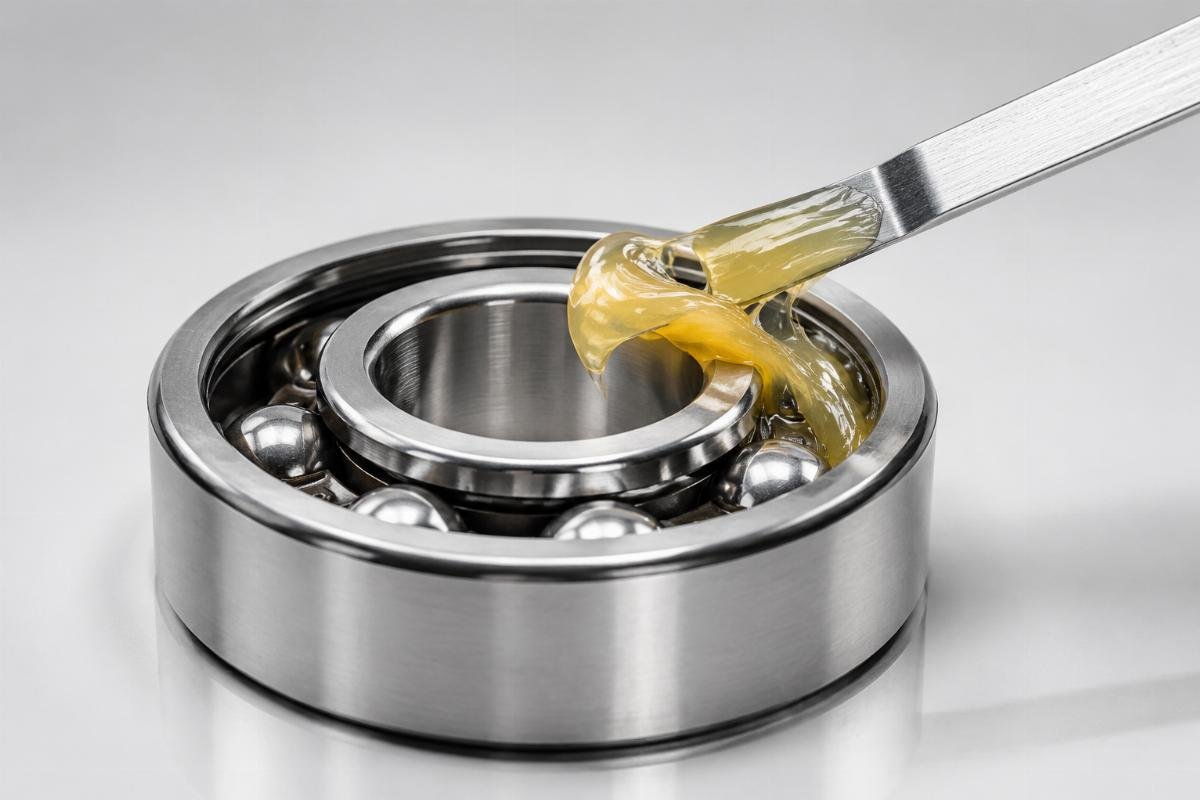
Understanding how industrial bearing lubrication interacts with load, speed, and environment is the foundation of any serious maintenance program. Let us walk through why it matters, where most facilities go wrong, and how to apply the right technique to each bearing type.
Why Does Proper Lubrication Matter for Industrial Bearing Longevity?
Lubrication is engineering protection, not a housekeeping task. The core function of any lubricant is to maintain a separating film between rolling elements and raceways, preventing metal-to-metal contact that drives friction, surface fatigue, and eventual spalling. Without this film, even premium-grade bearings will degrade rapidly.
| Performance Metric | Impact of Proper Lubrication |
|---|---|
| Friction Reduction | Minimizes energy loss noticeably compared to under-lubricated conditions |
| Heat Dissipation | Maintains operating temperatures substantially lower than unlubricated states |
| Corrosion Prevention | Creates a barrier against moisture and contaminants in harsh environments |
| Wear Protection | Distributes loads evenly across contact points, delaying surface fatigue |
| Seal Integrity | Prevents ingress of abrasive particles |
The operating environment dictates everything. A conveyor in a Southeast Asia steel mill was suffering monthly failures of 22320 spherical roller bearings, each incident pulling the line down for hours. The maintenance team was following a lubrication schedule, but the generic grease they used could not hold film strength under the combination of high load and elevated ambient temperature. After switching to an application-specific formulation matched to those conditions, the mill extended its mean time between failures (MTBF) from 30 to 92 days—a transformation that came from matching the lubricant to the real duty cycle, not from adding more of the same product.
When evaluating industrial bearing lubrication needs, five factors must be weighed together:
- Load magnitude – Heavier loads demand higher viscosity base oils or extreme pressure (EP) additives to maintain film strength under contact stress.
- Operating temperature range – Temperature swings shift viscosity; applications with wide thermal bands require synthetic formulations that resist thinning at peak heat and stiffening at cold start.
- Speed factor (dn value) – High-speed bearings need lower viscosity lubricants to limit churning resistance, which itself becomes a heat source.
- Environmental exposure – Moist, dusty, or chemically aggressive surroundings call for lubricants with corrosion inhibitors and compatible thickener chemistry.
- Contamination ingress risk – Sealing arrangement quality and lubrication tool cleanliness determine whether the film stays intact between relubrication intervals .
What Are the Most Common Lubrication Mistakes to Avoid?
Most preventable bearing failures trace back to lubrication errors, not material defects. The mistakes are rarely dramatic; they accumulate through small, repeated decisions that look sensible on the shop floor but compound into accelerated wear.
| Lubrication Aspect | Common Mistake | Correct Practice |
|---|---|---|
| Quantity | Overfilling "for safety" | Fill to manufacturer-specified cavity fraction (typically one-third to one-half) |
| Lubricant Type | One multi-purpose grease for every bearing | Match thickener, base oil viscosity, and additive package to bearing type and duty |
| Contamination Control | Reusing open containers and shared tools | Sealed containers, dedicated tools, filtered lubricants |
| Relubrication Interval | Rigid calendar-based schedules | Adjust intervals to operating conditions and condition monitoring signals |
| Compatibility | Topping up with unknown grease | Flush completely when switching thickeners; verify compatibility before mixing |
A European mining operation illustrates the cost of the first mistake vividly. Their crushers were fitted with 32220 tapered roller bearings that kept failing well short of expected life. The maintenance crew, believing more protection was better, had been applying roughly twice the recommended grease quantity. The excess grease had nowhere to go—it churned inside the housing, generating enough friction to raise operating temperature by 45°C, which in turn broke down the grease structure and destroyed the seals, letting contamination in. Once the quantity was corrected and a high-temperature EP grease was specified, failure rates dropped noticeably and bearing life extended from 4 to 6.5 months.
The second most dangerous mistake is mixing incompatible thickeners. Lithium-complex and polyurea thickeners, for example, can react to form a softened or hardened mixture that loses its ability to stay in place. Whenever a lubricant change is necessary, the old grease must be purged completely, the housing cleaned, and the new grease verified against the bearing manufacturer’s compatibility guidance .
Five discipline points separate facilities that avoid these traps:
- Never mix thickeners blindly – Lithium, polyurea, calcium sulfonate, and clay thickeners behave differently; cross-contamination causes structural collapse of the grease.
- Calibrate application tools – Grease guns should be metered; the one-third to one-half cavity fill rule prevents the churning that drives overheating.
- Enforce cleanliness at the point of application – Wipe fittings before injection, use filtered grease, and keep dedicated tools per lubricant type.
- Inspect seals at every relubrication – A damaged seal lets the new grease out and contamination in; replace seals as part of the relubrication cycle, not as a separate task.
- Record every intervention – Logging lubricant type, quantity, and date per bearing location reveals patterns that calendar schedules miss .
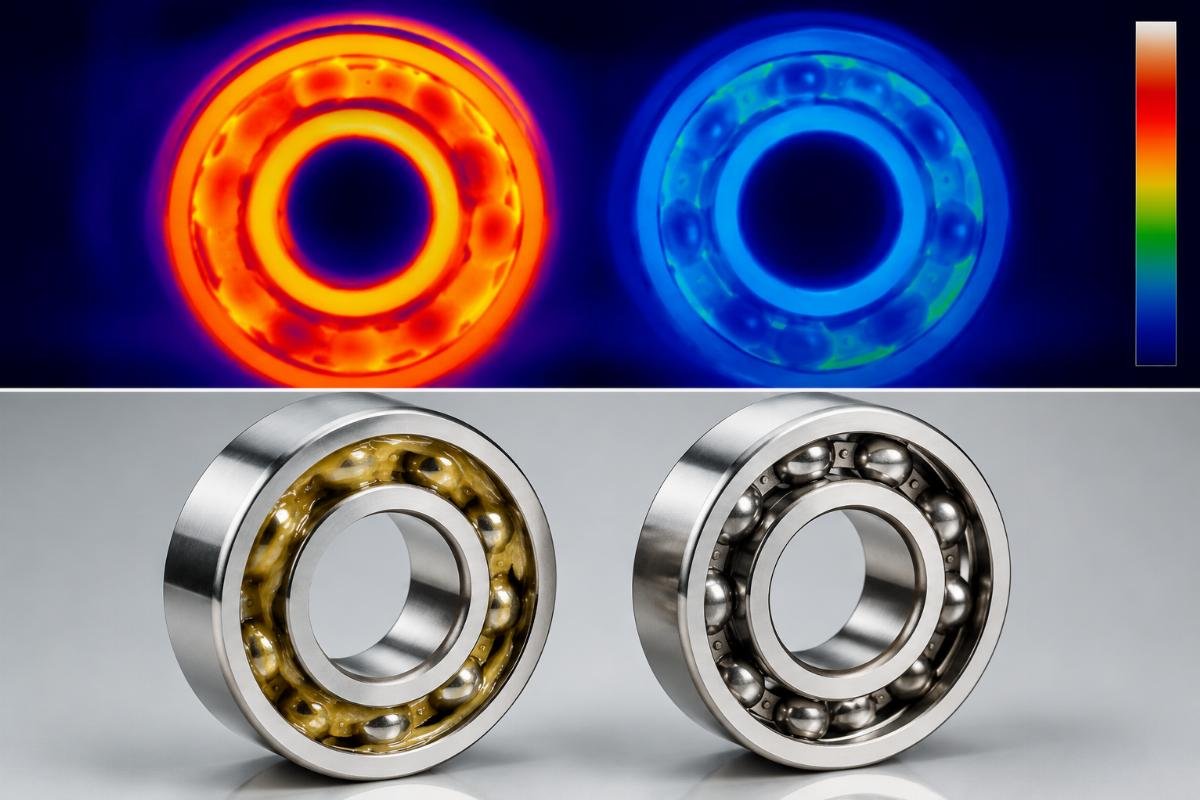
How to Properly Lubricate Different Types of Industrial Bearings?
Each bearing geometry demands its own lubrication approach; a single procedure does not fit all. The internal kinematics, load zones, and heat generation patterns differ enough between types that applying a uniform method will either starve some bearings or overfill others.
| Bearing Type | Recommended Lubrication Method | Primary Advantage | Ideal Application Scenarios |
|---|---|---|---|
| Deep Groove Ball Bearings | Grease packing (30-40% cavity fill) | Reduced maintenance frequency | Electric motors, pumps, moderate-speed conveyors |
| Spherical Roller Bearings | Forced grease lubrication | Accommodates misalignment and heavy radial loads | Steel mill roll necks, mining crushers, vibrating screens |
| Tapered Roller Bearings | Oil bath or controlled grease | Effective heat dissipation under combined loads | Gearboxes, wheel hubs, heavy-duty axles |
| Angular Contact Ball Bearings | Oil mist or circulating oil | Precision thermal control at high speed | Machine tool spindles, high-speed compressors |
| Thrust Bearings | Solid film or specialized grease | Handles pure axial loads efficiently | Turbine generators, propeller shafts, press applications |
For spherical roller bearings—the workhorse of heavy industry—a disciplined five-step procedure delivers consistent results:
- Clean the housing completely. Remove all old grease, metallic debris, and moisture. Any residue left behind contaminates the new charge and shortens its effective life.
- Inspect the bearing before filling. Check raceways and rollers for early fatigue signs, discoloration, or cage wear. Relubricating a damaged bearing only delays the inevitable.
- Apply grease to the inner race. Work the grease into the roller complement by rotating the bearing manually, ensuring the critical contact zones are coated before the housing is filled.
- Fill the housing to the correct fraction. For horizontal shafts, fill to 40% of the free cavity volume; for vertical shafts, reduce to 30% to limit churning at the upper roller zone.
- Reassemble with new seals and run in gradually. Start at reduced speed to allow the grease to distribute evenly across all contact surfaces before loading.
This procedure is where the traceability of the bearing itself becomes relevant. Using genuine SKF bearings with verified batch traceability ensures that the internal geometry, cage design, and surface finish match the lubrication parameters the manufacturer calculated—counterfeit or mis-specified bearings may have different internal clearances or surface textures that alter grease distribution and film formation.
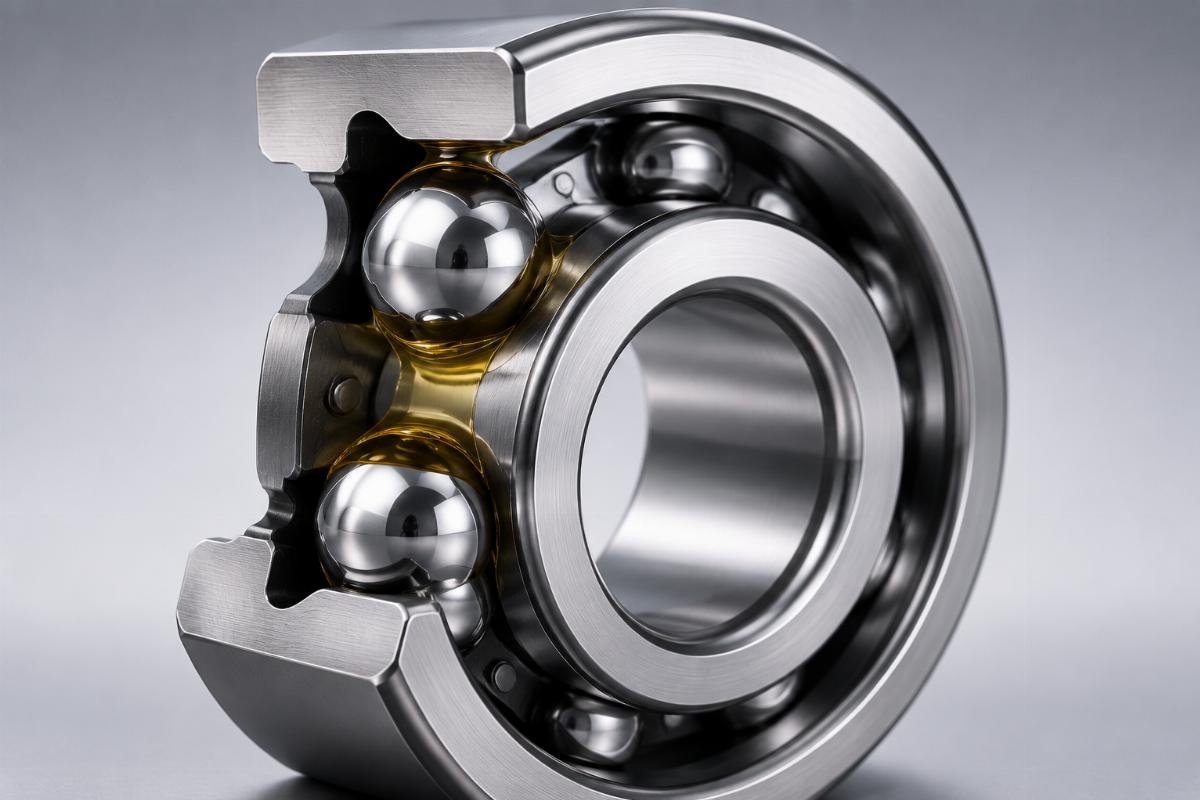
A wind energy asset manager provides a compelling validation of this disciplined approach. Their main shaft bearings—239/800 CA/W33 spherical roller bearings—were being replaced every 5 years, a costly intervention given the size and accessibility of these units. By implementing a controlled industrial bearing lubrication protocol, including precise grease quantity, a synthetic lubricant with EP additives, and condition-based relubrication intervals, the operator extended bearing service life to 7.5 years. That extension eliminated one full replacement cycle over the asset’s design life, reducing lifetime maintenance cost substantially. The lesson was not that more grease or more frequent changes would help—it was that the right amount of the right lubricant, applied with discipline, delivered the gains that brute force never could .
How to Verify Bearing Authenticity Before Lubrication?
No lubrication protocol can compensate for a bearing that was never built to specification. Before any grease touches a raceway, the bearing itself must be verified as genuine and correctly matched to the application’s clearance and precision requirements. This step is where many facilities unknowingly introduce risk into their maintenance programs.
Batch traceability is the foundation of this verification. Every SKF bearing carries a unique batch number that links back to production records, material certifications, and dimensional inspection data. When a maintenance engineer specifies a C3 clearance spherical roller bearing for a high-temperature application, the entire lubrication calculation—grease quantity, relubrication interval, film thickness expectation—assumes that internal clearance actually exists. If the bearing shipped was marked C3 but manufactured to CN tolerance, the interference fit at operating temperature will consume the clearance that was never there, and the bearing will run hot regardless of how perfectly the grease was applied.
I caught this exact mismatch years ago when a steel mill buyer in Brazil received a batch of spherical rollers marked C3. During our pre-shipment inspection, the dimensional check revealed they were actually CN tolerance—someone in the supply chain had mislabeled them. Under the client’s load and thermal profile, those bearings would have seized within months. The entire batch was held, verified against SKF’s traceability records, and replaced with correctly classified units before shipping. That single intervention prevented what would have been a costly field failure and a damaged relationship.
| Verification Dimension | What to Check | Why It Matters for Lubrication |
|---|---|---|
| Batch Number | Cross-reference against SKF traceability records | Confirms production origin and specification compliance |
| Clearance Class | Verify C2/CN/C3/C4 marking matches purchase order | Determines residual clearance after fitting and thermal expansion |
| Precision Class | Confirm P0/P6/P5/P4 rating matches application requirement | Affects internal geometry and grease distribution patterns |
| Packaging Integrity | Check for tamper-evident seals, correct SKF branding | First-line defense against counterfeit products |
| Dimensional Spot-Check | Measure bore, OD, and width on sample units | Catches manufacturing deviations that alter lubrication film |
The lubrication discipline points outlined earlier—correct quantity, compatible thickener, condition-based intervals—all depend on the bearing’s internal geometry behaving as the manufacturer designed it. A counterfeit or mis-specified bearing may have different cage geometry, surface finish, or internal clearance, all of which shift how grease distributes across the contact zones and how long the separating film survives under load.
Per-batch precision inspection before release is not excessive caution; it is standard practice for any SKF distributor serving critical industrial applications. When procurement teams receive bearings with full documentation—certificate of origin, batch traceability records, and dimensional inspection reports—they can proceed with lubrication protocols knowing the foundation is sound. This is particularly important for large-bore and special-clearance designations, where the cost of a field failure runs far beyond the bearing price itself.
For maintenance engineers building or revising their industrial bearing lubrication procedures, the sequence is clear: verify the bearing first, then apply the lubrication discipline. Skipping the verification step means building a precision maintenance program on an unverified foundation—a risk that no amount of grease can mitigate.
Conclusion
Industrial bearing lubrication is a precision discipline, not a volume game. Over-greasing, incompatible thickener mixing, and rigid calendar intervals drive a large share of preventable failures across heavy industry. Matching lubricant type, quantity, and relubrication interval to the actual operating environment—and verifying that the bearings themselves are genuine and correctly specified—delivers service life extensions that transform maintenance economics.

Leave a Reply