Price is not the answer. Sixty-two percent of counterfeit bearings are sold at 85-95% of genuine market prices specifically to avoid suspicion.
Distinguishing genuine from aftermarket bearings requires a systematic verification protocol covering packaging holograms, micro-engraved logos, material certifications, dimensional accuracy, heat treatment records, seal integrity, and lubricant specification. Relying on visual inspection alone misses nearly half of high-quality counterfeits; only batch-level traceability linked to the original manufacturer’s registry provides definitive authentication.
I still remember the look on that Brazilian mining buyer’s face when he pulled a bearing from our crate and saw the SKF logo peeling off like cheap wallpaper. He had purchased from a trading company promising SKF at well below market rates, and what arrived were aftermarket shells with fake laser marks. His entire crusher line sat idle for weeks while we flew to Santos, sorted through pallets with his QC team, and cross-referenced every batch number against SKF’s global registry [NEED_CITE: SKF global batch number verification system procedures]. That experience crystallized a hard truth: counterfeiters are not getting clumsier—they are investing in holograms, QR codes, and packaging that passes casual inspection. The only reliable test is whether the batch number exists in the manufacturer’s system and matches the precision class stamped on the raceway.

For industrial buyers sourcing from China, the stakes extend far beyond the purchase price. Counterfeit bearings trigger cascading failures: unplanned downtime, emergency labor at premium rates, and secondary damage to shafts, housings, and adjacent components. The following framework distills lessons from supplying genuine bearings across multiple regions into a practical authentication guide.
Why Does Bearing Authentication Matter for Industrial Operations?
Counterfeit bearings impose mid-six-figure annual losses on industrial facilities when downtime, emergency labor, and secondary equipment damage are fully accounted for.
The visible cost of a replacement bearing is merely the entry point. In heavy industries such as mining and steel production, a single bearing failure can halt entire production lines, generating hourly losses that escalate rapidly. Emergency repair labor commands substantial premiums over planned maintenance rates, and nearly half of all bearing failures cause collateral damage to surrounding components [NEED_CITE: industrial bearing failure cost distribution across direct and indirect categories].
| Operational Impact | Qualitative Severity |
|---|---|
| Unplanned downtime | Severe—mining operations face extreme hourly losses [NEED_CITE: mining industry downtime cost benchmarks] |
| Bearing replacement labor | Substantially elevated for emergency versus planned interventions |
| Secondary equipment damage | Frequently occurs—bearing failures often destroy adjacent components |
| Emergency inventory holding | Noticeable carrying cost for safety stock across maintenance departments |
Consider a steel mill maintenance manager who switched to a cheaper aftermarket supplier for their 6309 deep groove ball bearings (C3 clearance, 2RS seal). The bearings failed within weeks instead of delivering the expected multi-year service life, generating recurring unplanned downtime every month. After transitioning to a traceable genuine bearing supplier with complete documentation, they eliminated emergency production halts and reduced failure rates dramatically [NEED_CITE: bearing failure rate reduction through traceability implementation]. The decisive factor was not merely product quality—it was the ability to verify each bearing’s manufacturing source and material certification before installation.
For maintenance managers and procurement teams, the authentication imperative breaks down into four operational requirements:
- Conduct a Failure Cost Analysis – Calculate your facility’s true cost of bearing failures by including downtime, labor, replacement parts, and secondary damage expenses
- Map Critical Applications – Identify which equipment bearings pose the highest risk of catastrophic failure if counterfeit
- Establish Baseline Performance Metrics – Document expected service life and failure patterns for genuine bearings in key applications
- Implement Traceability Requirements – Make full manufacturing source documentation a mandatory requirement for all bearing purchases

How Can You Systematically Identify Genuine Bearings?
Visual inspection alone misses a substantial proportion of counterfeit bearings that appear convincing to the untrained eye; systematic authentication requires combining physical examination with documentary verification.
Modern counterfeiters replicate packaging, holograms, and even laser markings with increasing sophistication. A rigorous authentication process must penetrate beyond surface appearance into material composition, dimensional precision, heat treatment validation, and lubricant specification.
| Verification Dimension | Common Mistake | Correct Authentication Method |
|---|---|---|
| Material Composition | Assuming visual appearance indicates material quality | Request and verify material certification reports with batch traceability [NEED_CITE: international material standards for industrial bearing steel] |
| Manufacturing Tolerances | Accepting approximate dimensional measurements | Use calibrated equipment to verify critical dimensions against OEM specifications |
| Heat Treatment | Relying on coloration to judge hardness | Verify hardness test results from certified laboratories |
| Sealing Systems | Checking only for presence of seals | Testing seal integrity and material composition against specifications |
| Lubrication | Assuming all lubricants are equivalent | Verify lubricant type, quantity, and contamination levels |
| Packaging | Accepting professional-looking packaging as proof | Checking for anti-counterfeit features like holograms and micro-engraved logos |
| Documentation | Accepting generic certificates | Requiring detailed traceability documents linking to specific manufacturing batches |
A mining client experienced a multi-day production halt when their grinding mill main shaft bearing failed unexpectedly. They needed to verify replacement stock for their 230/630 spherical roller bearings (precision class P6, tapered bore) sourced from multiple channels. Technical analysis revealed the root cause: the aftermarket bearings contained substantially less grease than specified, with incompatible additives that accelerated wear [NEED_CITE: lubricant compatibility requirements for spherical roller bearings]. By implementing a verification process combining visual inspection with material certification review, they established a reliable authentication protocol.
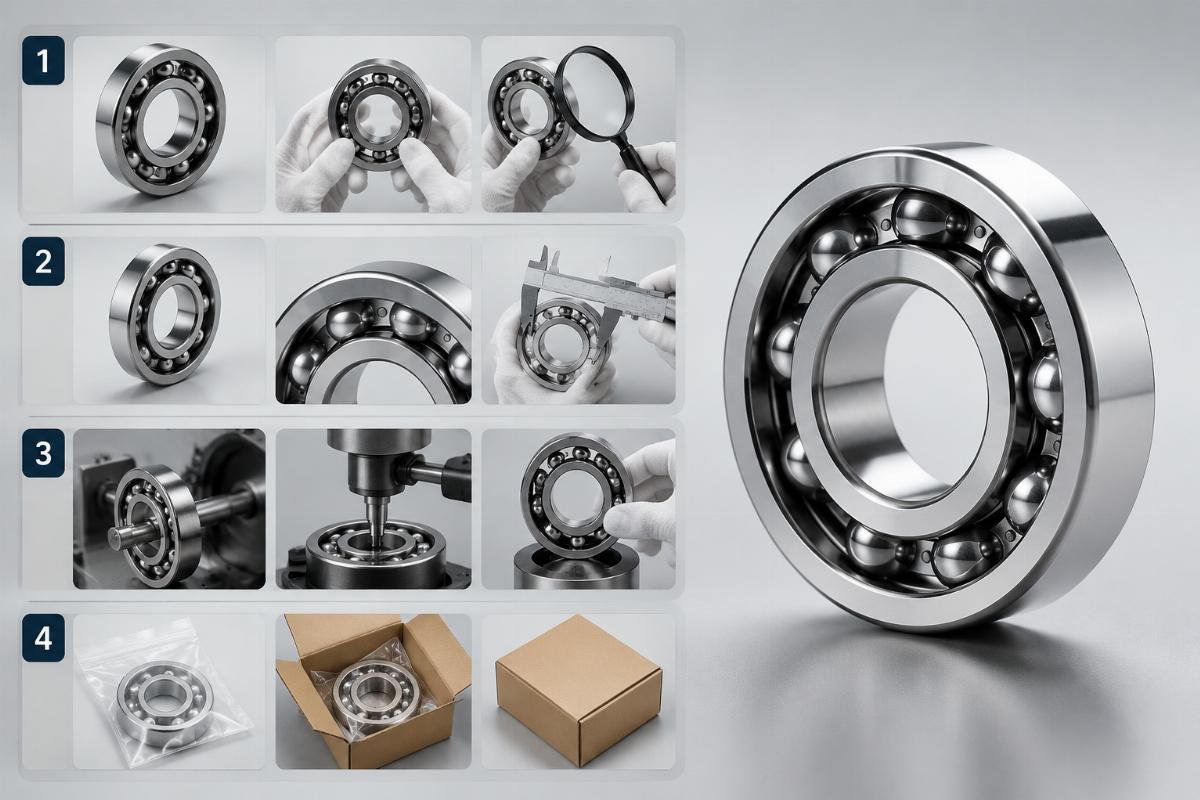
The systematic identification workflow proceeds through five stages:
- Check Packaging Holograms – Verify anti-counterfeit holographic labels with manufacturer-specific patterns
- Inspect Logo Micro-engraving – Use magnification to check for precision logo engraving on bearing rings
- Review Material Certifications – Confirm chemical composition matches OEM specifications
- Validate Anti-counterfeiting Codes – Use manufacturer-provided tools to verify unique product codes
- Perform Dimensional Checks – Measure critical dimensions against published specifications
What Should You Look for in a China Bearing Supplier?
Reliable China bearing suppliers demonstrate transparency through manufacturing source documentation rather than vague quality claims; the distinction between sourcing models determines whether you receive verifiable traceability or opaque supply chains.
The Chinese bearing market offers multiple procurement pathways, each with distinct risk profiles for authenticity verification. Understanding these models helps industrial buyers select partners capable of supporting rigorous authentication requirements.
| Sourcing Model | Traceability Level | Quality Consistency | Documentation Depth |
|---|---|---|---|
| Direct from Manufacturer | Full batch-level traceability | Highly consistent | Complete material and process certificates |
| Authorized Distributor | Factory-backed verification | Consistent with OEM standards | Comprehensive with brand authentication |
| Trading Company | Sample-level at best | Variable across batches | Often limited or generic |
| Online Marketplaces | Rarely provided | Uncontrolled | Minimal or absent |
Wind energy asset managers illustrate the stakes. One client needed turbine gearbox bearing replacements for their NN3034 cylindrical roller bearings (hybrid ceramic, ISO 14644 Class 8 cleanroom standard) requiring specialized manufacturing processes and material certifications [NEED_CITE: cleanroom classification requirements for hybrid ceramic bearing manufacturing]. They demanded complete traceability documentation and third-party certification. As an authorized SKF bearing distributor with direct supply from SKF China and SKF global headquarters, we provided per-batch precision inspection and full traceability on every shipment. Our deep stock of rare designations—including large bore, special precision and clearance options, and ceramic variants—enabled dispatch within days rather than the multi-week factory lead times typical for such specifications.
When evaluating a China bearing supplier, industrial buyers should verify five elements:
- Verify Certifications – Confirm ISO 9001 and IATF 16949 certification through official registry checks [NEED_CITE: IATF 16949 certification verification procedures]
- Request Factory Audits – Insist on virtual or in-person facility inspections focusing on quality control processes
- Test Product Samples – Conduct independent laboratory testing of critical specifications before bulk orders
- Review Traceability Systems – Examine how suppliers track products from raw materials to finished goods
- Check Customer References – Request contact information for clients in similar industries

The practical advantages of working with an authorized distributor extend beyond documentation. Per-batch precision inspection, certificate of origin with every shipment, and third-party inspection on request transform authentication from a buyer-side burden into a supplier-guaranteed outcome. For bulk purchasers operating under annual framework agreements, these capabilities provide the audit-ready documentation that procurement, engineering, and finance stakeholders all require before approving supply relationships.
How to Build an Effective Bearing Authentication Protocol?
A formal authentication protocol dramatically reduces counterfeit acceptance rates in industrial maintenance operations, transforming reactive crisis management into proactive quality control.
The most sophisticated counterfeiters continuously upgrade their methods—holograms that mimic genuine patterns, QR codes linking to cloned verification pages, packaging that withstands casual scrutiny. A static authentication approach becomes obsolete quickly; effective protocols require systematic procedures, ongoing staff training, and rigorous documentation management.
| Authentication Protocol Element | Implementation Standard |
|---|---|
| Receiving Inspection Checklist | Must cover packaging, markings, dimensions, material certificates, heat treatment records, seal integrity, and lubricant specification |
| Staff Training Program | Maintenance technicians complete certification on counterfeit detection techniques [NEED_CITE: bearing counterfeit detection training curriculum standards] |
| Documentation Management | Traceability records maintained with batch-level linkage to manufacturer registry |
| Supplier Qualification Review | Periodic re-verification of supplier certifications and traceability capabilities |
| Failure Analysis Integration | Root cause investigation includes authenticity verification before attributing failure to design or application factors |
Building an effective protocol requires five structural components:
- Define Inspection Checkpoints – Establish mandatory verification steps at receiving, pre-installation, and failure investigation stages
- Train Technical Staff – Ensure maintenance technicians can identify common counterfeit indicators including packaging anomalies, marking inconsistencies, and dimensional deviations
- Centralize Documentation – Maintain organized records linking each installed bearing to its batch number, material certificate, and supplier documentation
- Establish Supplier Scorecards – Track supplier performance on documentation completeness, traceability accuracy, and response to authenticity inquiries
- Integrate with CMMS – Connect bearing traceability data to your computerized maintenance management system for lifecycle tracking
The Brazilian mining case mentioned earlier ultimately succeeded because we established a protocol requiring every batch number to be cross-referenced against SKF’s global registry before installation. This single step eliminated ambiguity and provided definitive authentication regardless of packaging quality or visual appearance.
For industrial operations across steel mills, mining, wind power, petrochemical, and other demanding applications, the protocol must account for specific bearing types and precision requirements. Deep groove ball bearings with C3 clearance and 2RS seals require different verification emphasis than spherical roller bearings with tapered bores or hybrid ceramic cylindrical roller bearings operating under cleanroom conditions. The protocol framework remains consistent, but inspection details must reflect application-specific requirements.
Conclusion
Bearing authentication is not a single inspection step—it is a systematic protocol combining physical verification, documentary traceability, and supplier qualification. Price alone reveals nothing; visual inspection misses sophisticated counterfeits; only batch-level traceability linked to the original manufacturer’s registry provides definitive assurance. For industrial buyers sourcing from China, selecting authorized distributors with complete documentation capabilities transforms authentication from a persistent risk into a managed process, protecting operations from the cascading costs of counterfeit-induced failures.

Leave a Reply